

Most warehouse management systems (WMS) are selected based on how well they can handle an operation today. But warehouses rarely stand still for long.
Order profiles change. New customers come onboard. Retailers add e-commerce channels. Peak volumes put new pressure on workflows. 3PLs take on clients with entirely different fulfillment requirements. Automation gets introduced. Business rules that made sense two years ago may no longer reflect how the operation needs to run.
That is why one of the most important questions to ask when evaluating a WMS is not simply, “Can it support our requirements?” It is, “How easily can it change when our requirements do?”
The answer often comes down to an important distinction between customization and configurability.

Customization and Configurability are Not the Same Thing
A customized WMS can be changed to meet specific requirements, but those changes often depend on software development. New code may need to be written, tested, and deployed each time the operation needs something outside the standard functionality.
That can solve an immediate problem, but it can also create longer-term complexity. As customizations accumulate, upgrades become more difficult, support requirements increase, and even relatively small operational changes can become technology projects.
A configurable WMS takes a different approach. Instead of changing the underlying software, users can adjust how the system operates through rules, workflows, and settings already built into the platform.
That distinction becomes increasingly important after go-live.
The warehouse you implement today will almost certainly not be the warehouse you are running several years from now. The more easily the WMS can adapt to the operation, the less likely technology is to become the constraint.
Operational Change Should Not Always Require a Development Project
Consider something as simple as a change in order priorities.
A warehouse may initially prioritize orders by carrier cutoff. Later, a high-value customer requires different service levels. E-commerce growth introduces same-day orders. A new shipping method changes the sequence again.
The warehouse needs to respond, but the fundamental WMS does not need to be rewritten every time the business changes.
SnapFulfil was designed around a highly configurable workflow rules engine that allows warehouse processes and business rules to be adapted without relying on custom code for every change. That gives operations teams more flexibility to adjust how work is executed as requirements evolve.
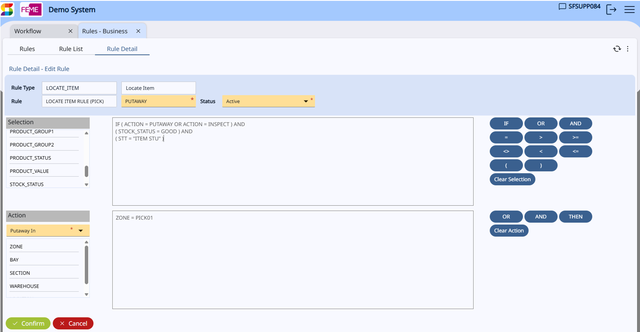
The same principle can apply across receiving, put-away, replenishment, picking, packing, shipping, and other warehouse processes.
Configurability is not about changing things simply because you can. It is about giving the operation room to evolve without turning every process adjustment into an IT project.
For 3PLs, Flexibility Can Directly Affect Growth
The issue becomes even more important for third-party logistics providers.
A manufacturer or retailer may have one primary operating model. A 3PL can have dozens, each with different inventory rules, order profiles, integrations, shipping requirements, SLAs, and reporting expectations.
Every new customer potentially introduces another variation.
If the WMS requires extensive development every time a client comes onboard, technology can slow the sales-to-operations handoff and extend implementation timelines. In a competitive 3PL market, that can become more than an IT problem. It can affect how quickly the business can begin generating revenue from a new account.
A configurable platform allows more of those differences to be handled through workflows and rules rather than separate custom software.
The result is not that every customer operates the same way. It is that the 3PL has a common technology foundation capable of supporting different operating models.
That distinction matters as 3PLs grow, add customers, and expand across facilities.
Peak Season is Another Test of WMS Adaptability
Peak periods expose rigid warehouse processes quickly.
Order volumes increase, labor changes, priorities shift, and processes that work comfortably during normal demand may no longer be the most efficient way to move orders through the building.
Warehouses may compensate by adding staff or relying on manual workarounds. But when the WMS can adapt, operators have more options.
Picking strategies can change. Work can be prioritized differently. Replenishment rules can be adjusted. Processes can be refined to reflect the way the warehouse actually needs to operate under peak conditions.
Then, when demand normalizes, those workflows can change again.
This is what practical adaptability looks like inside warehouse execution. It is not a theoretical promise that the software is “flexible.” It is the ability to change the way work gets done when operating conditions change.
Integration Requirements Change Too
Warehouse processes are only one part of the picture.
Businesses change ERPs, carriers, e-commerce platforms, and automation technologies. 3PLs regularly onboard customers with systems that differ from those of every other client in the building.
As the technology ecosystem around the WMS expands, integration flexibility becomes just as important as workflow flexibility.
The goal should not be to predict every system the warehouse will ever need to connect with. That is impossible. The goal is to have an architecture and integration approach that does not assume today's technology stack will remain unchanged indefinitely.
The same principle applies to automation. A warehouse may start with predominantly manual processes, introduce conveyors or pick-to-light systems, and later add robotics or other automated technologies.
A WMS should be able to evolve with that journey rather than forcing the operator to redesign the technology environment around the limitations of the software.
The Real Test Comes After Implementation
Implementation speed matters. Functionality matters. Integration capabilities matter. But WMS value is measured over years, not simply during the implementation project.
A system that fits an operation perfectly on day one but becomes increasingly difficult to change can eventually limit the business it was meant to support. A configurable WMS gives operators another option: establish a strong foundation, then continue adapting the execution model as the business changes.
That is particularly important in an industry where customer expectations, labor availability, fulfillment channels, and automation strategies continue to evolve.
When evaluating a WMS, asking whether the system can meet today's requirements is only the beginning.
The more revealing question is:
What happens when those requirements change?
With SnapFulfil, configurability is built into the way the platform works, helping warehouse operators adjust workflows and rules without having to rebuild the WMS around every new operational requirement.
Because the best warehouse technology should not just fit the operation you have today.
It should give you room to build the operation you need next.